
Recently, BYD Commercial Vehicles successfully concluded its 2025 extreme low-temperature test in Heihe City, Heilongjiang Province – a “key northern border town” where temperatures plummet to as low as -36.4℃. Launched in December 2025, the two-month test assembled 11 vehicle models covering public transportation, logistics, ports, construction and other fields, with seven test categories including energy consumption, heating, acceleration and braking. Media were specially invited to participate in dynamic test rides of the pure electric bus C11 and hybrid light truck T5, allowing them to intuitively experience the vehicles’ outstanding performance in extreme low-temperature environments.
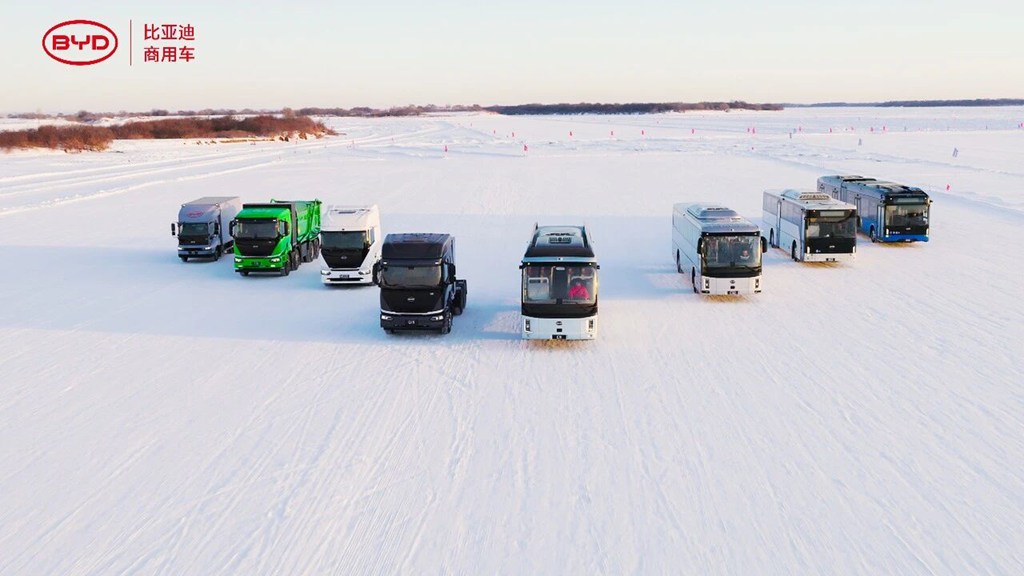

For a long time, under extreme low temperatures and complex icy and snowy road conditions, users have generally faced pain points such as difficult cold starts, ineffective braking on icy roads, easy steering drift and poor driving stability, which seriously affect operational efficiency and driving safety. Through comprehensive and high-intensity test verification, this extreme cold test provides technical support for BYD Commercial Vehicles to solve users’ actual operational problems.
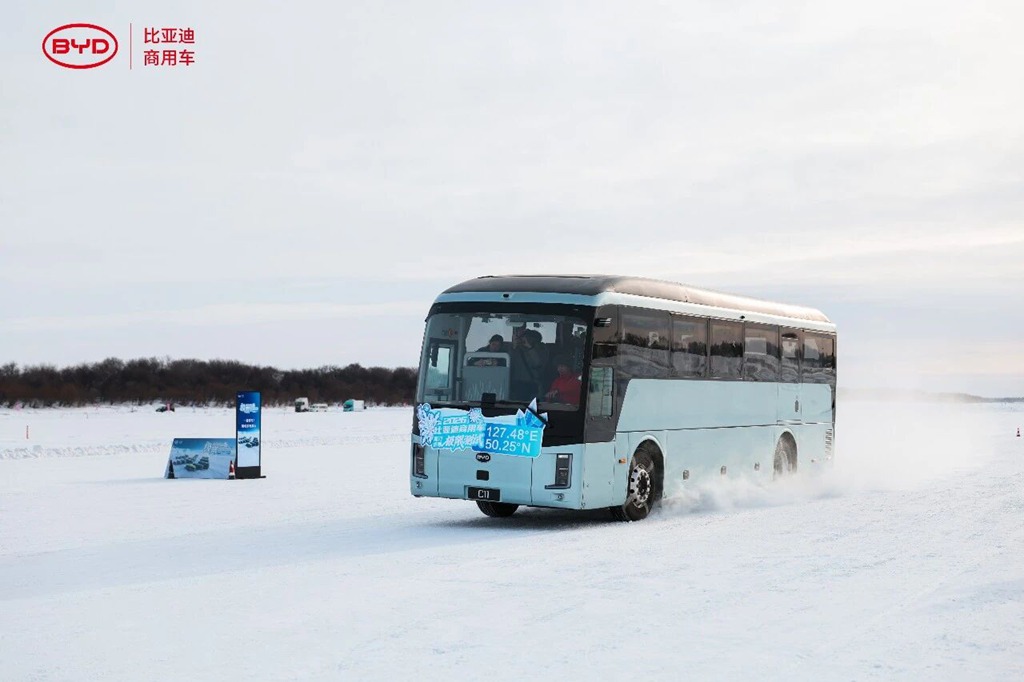
Addressing the cold start challenge of new energy vehicles in winter, the T5 and C11 underwent cold soak start tests. After being parked outdoors in low temperatures for a long time, relying on the power battery thermal management system, the temperature of the battery cells was precisely controlled within the optimal operating range, successfully achieving rapid startup and stable response.
The icy moose test, S-curve test and circular track test focused on solving user pain points such as “difficulty in emergency obstacle avoidance” and “easy drift in curves”. During the test, the C11 simulated a real-road speed of 55km/h. Faced with sudden obstacle scenarios, it achieved millisecond-level suspension response adjustment through the bus Yunlian A system, accurately regulating power distribution and body posture to successfully complete extreme obstacle avoidance, while balancing driving stability and riding comfort in continuous curves. The T5, relying on chassis tuning and the ESC body stability system, maintained precise steering on low-adhesion icy and snowy roads, effectively suppressing cornering drift.
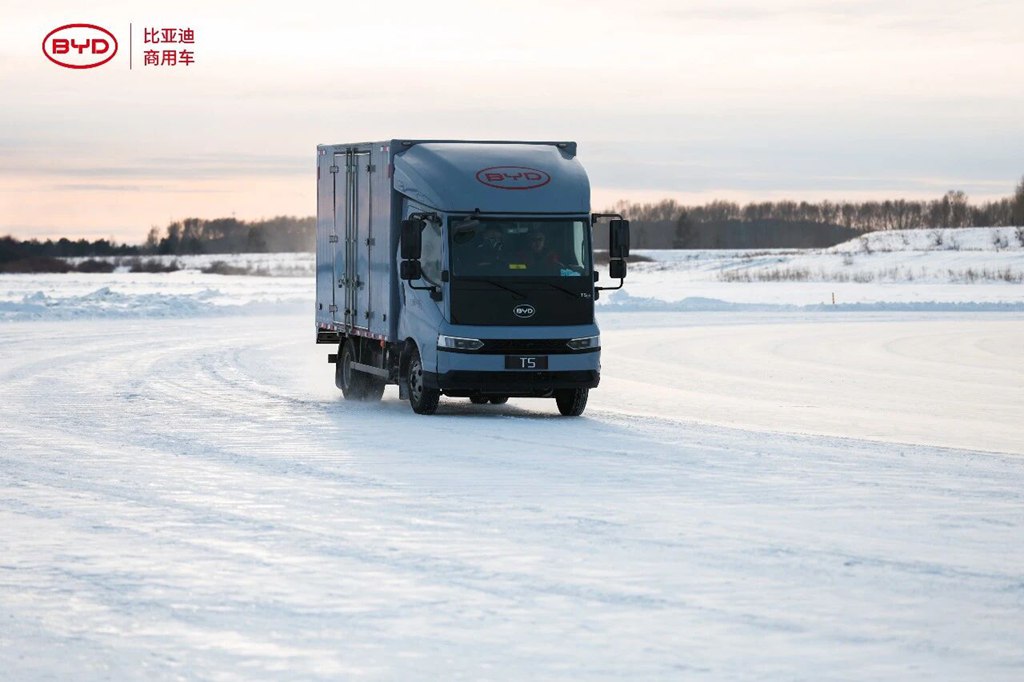
Targeting the problem of “ineffective braking on icy roads”, the emergency braking test showed that both models’ braking systems responded sensitively, with stable body posture throughout the process. They effectively avoided wheel lock-up and body nodding, resolving users’ concerns about excessively long braking distances and vehicle loss of control when driving on icy and snowy roads.
As one of the earliest new energy vehicle enterprises in the industry to carry out “high cold, high temperature and high altitude” tests, BYD Commercial Vehicles has conducted the “three highs” tests for nine consecutive years, accumulating 1,336 test days, involving 128 test vehicles, completing 484 test items and 3,670 test runs, with dynamic test mileage exceeding 2 million kilometers.

In addition, the vehicles have undergone thousands of tests including battery needle penetration, collision, rollover and NVH tests, jointly constructing a rigorous full-scenario and all-dimensional test system, laying a solid foundation for the efficient operation of buses and trucks.
Currently, BYD Commercial Vehicles has achieved large-scale operation in many extreme cold regions at home and abroad. In Nordic countries such as Norway, Sweden and Finland, BYD electric buses have won a good market reputation with stable performance. The earliest batch of buses has been in operation for more than 8 years, fully verifying their reliable quality in extreme cold environments.
